
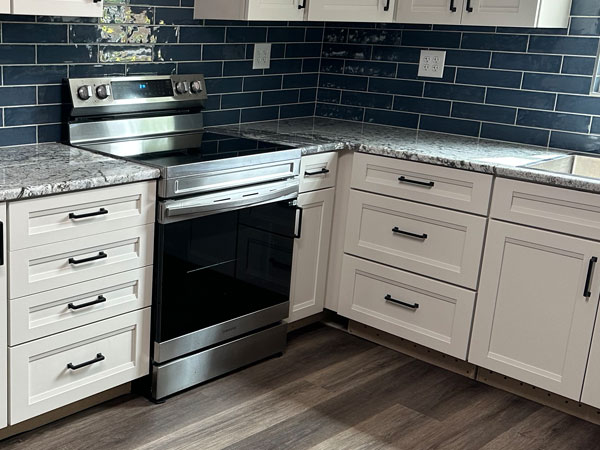
The ketchup, grape juice, and coffee your family spills on the cabinets every week sit on a testing lab's checklist. Certified kitchen cabinets are deliberately smeared with all three, left for a full day, and only pass if the finish shows no damage. That is the useful truth behind a family kitchen refresh: the surfaces that survive real life are the ones built and tested to survive it, and you can choose them on purpose instead of hoping. A refresh that lasts comes down to two decisions, cabinets finished and built to a real standard and countertops hard and non-porous enough to take daily abuse, and both are easier to judge once you know what to look for.
What Makes a Cabinet Survive a Family Kitchen?
A cabinet survives a family kitchen when it's built and finished to the ANSI/KCMA A161.1 standard, the benchmark that separates cabinets made to last from cabinets made to a price. The Kitchen Cabinet Manufacturers Association, the trade group that runs cabinet certification in the United States, publishes the only performance standard for kitchen and bath cabinets, and it's genuinely demanding. Certified cabinets go through five categories of testing, and one of them loads every shelf and bottom at 15 pounds per square foot and holds that weight for seven straight days to prove nothing sags, separates, or pulls loose from the wall.
The KCMA standard matters most in exactly the kitchen this refresh is built for. A cabinet that shrugs off a week under load is one that will hold a stack of everyday dishes and a toddler hanging on an open door without racking out of square. When you shop for cabinets, look for the KCMA certification seal inside the door, and ask whether the line you are considering carries it. It's the closest thing to a warranty you can verify before anything is installed.
The Cabinet Finish Test Is Basically Your Breakfast Table
The KCMA finish test is a near-perfect stand-in for a week of family breakfasts. To earn certification, a cabinet's exposed surfaces are left under vinegar, lemon, orange and grape juice, ketchup, coffee, olive oil, and 100-proof alcohol for a full 24 hours, plus mustard for an hour, and the finish has to come through with no stain, no blistering, and no whitening. Read that list again: it's almost everything a kid can knock over at a kitchen table, and a certified finish is proven to take it. Real life, tested.
The same test bakes and freezes the doors to catch finishes that would fail near a heat source or a cold wall. Certified doors spend 24 hours in a hotbox at 120 degrees and 70 percent humidity, then an hour in a coldbox at minus 5 degrees, which is roughly the range between the cabinet beside your oven and one on an exterior wall during a Front Range cold snap. A finish that crazes or peels under that swing never earns the seal. For a busy household, this is the difference between doors that still look new in ten years and doors that show every splash and steam cloud within two.
Cabinet Construction That Actually Holds Up
Beyond the finish, family-proof cabinets are the ones whose moving parts are tested to outlast heavy use. In the KCMA protocol, doors are swung through a full 90-degree arc for 25,000 cycles and drawers are run 25,000 times under load, which stands in for years of a household opening the same trash-drawer and the same cup cabinet thousands of times a year. Cheap hinges quit first. Hardware is where budget cabinets give up, so it is worth paying attention to.
Two upgrades pay for themselves in a house with kids. Soft-close hinges and drawer glides take the slam out of a hundred daily closings, which saves both the doors and the fingers, and full-extension glides on a solid drawer box let a drawer carry real weight without sagging. When we plan a kitchen refresh, this is the kind of detail we walk through with you, because it's invisible on a showroom sample and obvious three years into daily use. You can see the range of what fits your kitchen in our kitchen remodeling work.
Which Countertops Take a Beating Best?
Hardness decides how a countertop survives daily life, and on the Mohs scale that geologists use to rank scratch resistance, the family-friendly surfaces sit at the top. Engineered quartz lands at about 7 and granite at 6 to 7, both well above the 4 to 4.5 of a steel knife blade, so neither picks up scratches from ordinary cooking. Marble is the soft one at about 3, barely harder than a fingernail, which is why it collects fine scratches and etch marks in a kitchen where nobody has time to baby it. For a household that cooks hard and cleans fast, the harder surfaces win easily.
Quartz has a second advantage that matters even more with kids and pets: it's non-porous. Engineered quartz is about 90 to 93 percent ground quartz bound with 7 to 10 percent resin, and that resin seals the surface so completely that spilled juice, sauce, and pet accidents wipe up with no stain and no sealing required, ever. Spills just wipe away. The one trade-off is heat, since the resin can scorch, so a trivet by the stove is the single habit a quartz kitchen asks of you. Granite matches quartz for hardness and beats it on heat, but as a natural stone it wants periodic sealing to stay stain resistant.
The Low-Maintenance Choice for a Busy Kitchen
Quartz is the low-maintenance countertop for a busy kitchen, and the surface most Castle Rock families land on, because it removes the two chores natural stone asks for. It never needs sealing, and acids that would etch marble do nothing to it, so a morning of spilled orange juice and a dropped berry smoothie is a ten-second wipe rather than a stain to worry about. The Natural Stone Institute is candid that porous stones like marble and granite take a periodic impregnating sealer for stain resistance, and that marble etches when acids touch it, which is honest information that simply points a hard-use family toward quartz for the counters that see the most action.
None of this rules out natural stone in a family home. A granite island paired with quartz on the hardest-working runs, or a marble baking niche kept away from the citrus, can be the right mix for the right household. The choice is less about which material is best and more about matching each surface to how that part of the kitchen gets used, and we help you sort that out in our guide to quartz versus natural stone for Castle Rock kitchens.
A Family-Proof Kitchen at a Glance
| Choice | Family-proof pick | Why it survives real life |
|---|---|---|
| Cabinet standard | KCMA-certified (ANSI/KCMA A161.1) | Tested against juice, ketchup, coffee, 25,000 door cycles, 7-day load |
| Cabinet finish | Factory-cured, KCMA-tested finish | Proven against stains, heat, and cold without crazing |
| Cabinet hardware | Soft-close hinges and full-extension glides | Takes the slam out of daily use; carries weight without sagging |
| Hardest-working counters | Engineered quartz | Non-porous, no sealing, Mohs 7 scratch resistance |
| Statement counters | Granite or quartzite | Hard and heat-proof; periodic sealing |
Questions We Get About Family-Proof Kitchens
Are quartz countertops good for families with kids?
Yes, quartz is one of the best countertops for families with kids. It is non-porous, so spilled juice and food wipe up without staining and it never needs sealing, and at about 7 on the Mohs hardness scale it resists the scratches of everyday cooking. The only rule is to use a trivet, since the resin that makes quartz stain-proof can scorch under a hot pan.
What cabinet finish holds up best in a busy kitchen?
A factory-cured finish on a KCMA-certified cabinet holds up best, because it has been lab-tested against exactly the messes a kitchen sees. The KCMA standard leaves juice, ketchup, coffee, and alcohol on the finish for 24 hours and cycles it through heat and cold, and only finishes that survive with no staining or crazing earn the seal. Look for that certification rather than judging a finish by how it looks on a showroom sample.
Do painted cabinets chip in a family kitchen?
Painted cabinets can chip at high-wear edges over years of hard use, more so than a stained or thermofoil finish, though a quality factory paint holds up far better than a hand-painted one. If your family is hard on cabinets, ask about the finish process and whether the line is KCMA-certified, and consider a satin sheen, which hides fingerprints and small marks better than a high gloss.
Is marble a bad idea with kids and pets?
Marble is not a bad idea, but it's the highest-maintenance choice, so it suits some family kitchens and not others. Marble is soft at about 3 on the Mohs scale and etches when acids like citrus or tomato touch it, and sealing slows staining but doesn't stop etching. Many families use marble on a low-traffic baking area and a harder surface like quartz on the main runs, which keeps the look without the daily worry.
What is the most durable countertop overall?
Engineered quartz and quartzite are the most durable countertops for a hard-use kitchen, both sitting near 7 on the Mohs scale for scratch resistance. Quartz adds the advantage of being non-porous and sealing-free, while quartzite and granite handle heat better as natural stones. Any of the three will outlast marble in a busy household by a wide margin.
Refresh Your Kitchen to Last
A kitchen that survives kids, pets, and busy mornings is not luck; it's a series of choices you can make deliberately, from a certified cabinet finish to a non-porous countertop and soft-close hardware that takes the daily slam. As a family-owned firm, we plan and install these refreshes across Castle Rock and the Denver metro, and we would rather steer you toward surfaces that fit your household than sell you a look you will fight with. When you are ready to build a kitchen that holds up, request a free estimate and we will walk your space, your habits, and the choices that will still look right when the kids are grown.