

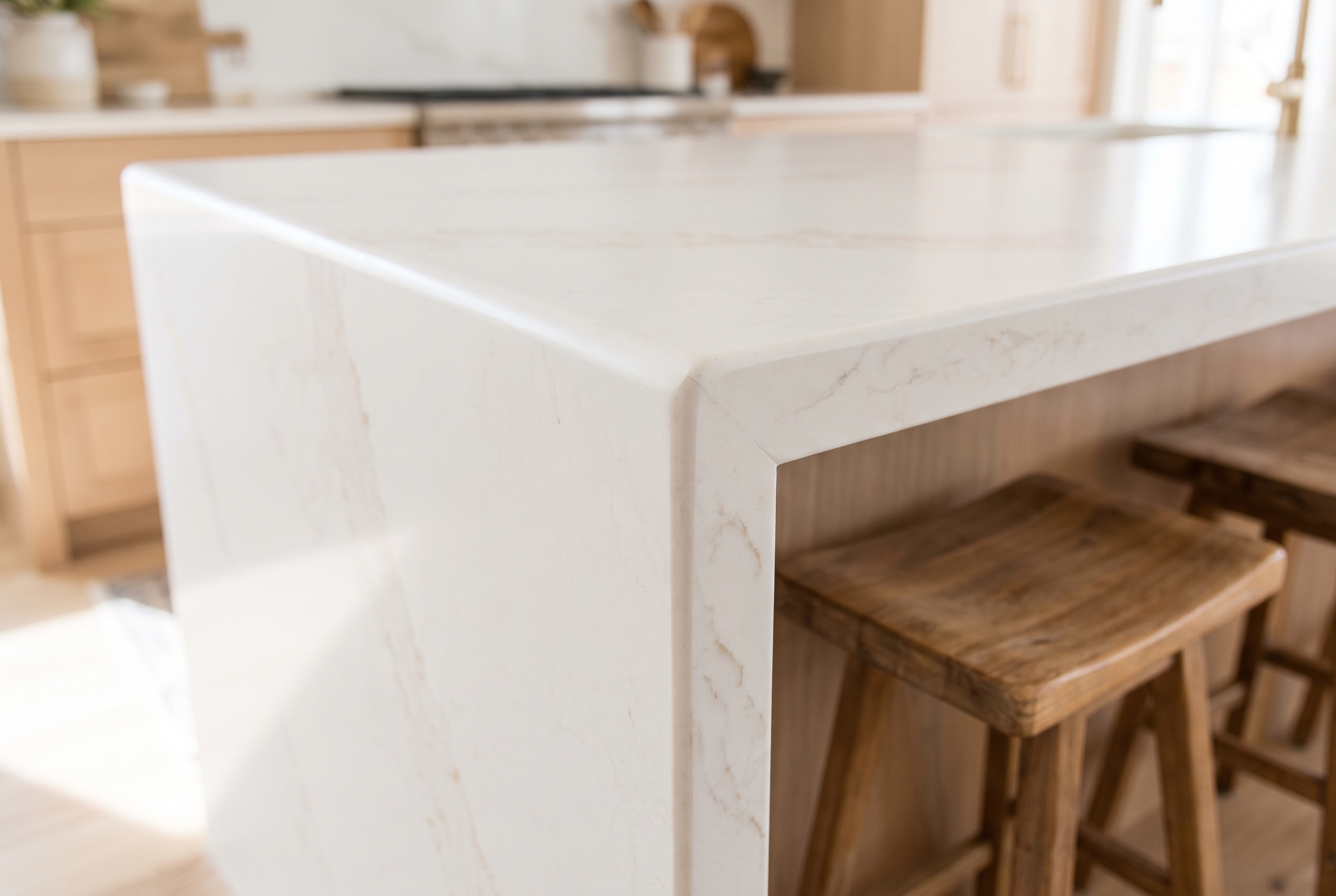
For most kitchens the right countertop edge is an eased edge, a square edge with its sharp corners just softened. It looks crisp, wipes clean in one pass and handles the knocks that chip a knife-sharp corner. Choose a rounder bullnose where toddlers and hips meet the counter, a thick mitered edge on an island you want to read as furniture, and a shaped ogee only in a traditional room, cut in granite or marble.
| Edge | Looks | Best for | Watch for |
|---|---|---|---|
| Eased | Square, corners softened | Most kitchens | Round the outside corners too |
| Straight | Crisp right angle | Minimal, modern rooms | Sharpest edge; chips first |
| Bevel | 45-degree cut on top | Transitional rooms | A deep bevel adds a second corner |
| Half bullnose | Rounded top, flat bottom | Families, traditional rooms | Reads a little thinner |
| Full bullnose | Rounded top and bottom | Toddlers, bars | Drips run underneath |
| Ogee | S-shaped curve | Traditional granite or marble | Crumbs in the curves; costs more |
| Mitered | Thick; pattern wraps the edge | Islands, modern kitchens | Needs a well-matched joint |
What a Countertop Edge Profile Is
A countertop edge profile is the shape cut and polished into the exposed front and sides of a countertop. It's done when the slab is fabricated, before installation, and it changes more than looks: how the edge feels when you lean on it, how easily it chips, how it cleans and what it costs.
A few terms come up when you choose one. The arris is the sharp line where the top of the slab meets its edge, and most profiles exist to soften it. A built-up edge adds a strip of stone at the front to make the counter look thicker. The standard edge is the one included in a countertop's price, usually eased.
On the countertops we install, we measure, cut and install quartz, granite and marble tops, so the edge is chosen along with the slab, the sink and the layout instead of as an afterthought.
The Common Edge Profiles, From Eased to Ogee
The types of countertop edges run from nearly square to fully rounded to shaped and built up, and each has a look, rooms it suits and a way it handles knocks and crumbs.
Square and Eased Edges
An eased edge is a square edge with its top and bottom corners slightly rounded. Cambria, whose quartz we carry, lists it as its simplest and most popular profile. It suits modern and transitional kitchens, shows off the top of the slab, and is the edge most fabricators include in the countertop's price.
A straight or square edge keeps the corner almost sharp, with a radius of about 1/8 inch. It reads crisp and architectural, but a sharp corner is the first place a dropped pan takes a chip, so the eased version is the safer everyday choice.
Pencil and small-radius edges sit between eased and bullnose. They give the top corner a slightly bigger roundover that feels softer under your forearms without changing the square look much.
Beveled Edges
A beveled edge has its top corner cut at an angle, typically 45 degrees, which catches light and reads a little more tailored than an eased edge. A double bevel cuts the top and the bottom.
How a bevel handles knocks depends on its size. A small bevel protects the corner the way an eased edge does. A deep bevel leaves two corners where there was one, at the top and the bottom of the angled face, and either can chip.
Bevels suit transitional and traditional rooms and clean easily. They work best on a 3 cm slab, where there's enough thickness for the angle to read.
Half and Full Bullnose
A half bullnose rounds the top of the edge and leaves the bottom flat; a full bullnose rounds both, so the edge is a half circle from the side. Both come on 2 and 3 cm slabs, and both leave no sharp corner where people walk past.
The trade-offs are small but real. A full bullnose lets drips run around the curve and under the counter instead of dropping straight to the floor, and the rounded shape makes the slab read thinner from across the room. A half bullnose keeps a crisp underside and a softer top.
Use a half or full bullnose on an island where small children run, at a bar where people lean, and in a traditional or farmhouse kitchen where a rounder edge suits the cabinets.
Ogee, Dupont and Other Decorative Edges
An ogee edge is an S-shaped curve, convex over concave, and it's the classic traditional profile. Related shapes include the dupont, a stepped profile with a square shoulder, and the cove, a concave scoop. A full ogee usually needs the edge built up to about 4 cm, while shorter ogees fit a standard 3 cm slab.
Decorative edges belong in traditional rooms, and they look best in granite and marble, where the stone's own pattern runs around the curve. The thin lip at the top of an ogee is the part that chips first, and the curves collect crumbs, so a decorative edge asks for a little more care.
They also cost more per foot than a bullnose or a bevel, because each curve takes more passes of the cutting and polishing tools.
Mitered and Laminated Edges
Mitered and laminated edges make a countertop look thicker, often 2 inches or more, by adding a strip of stone at the front, so a lighter slab reads as a heavy one. Where they differ is in the joint.
A laminated edge stacks the strip under the top, so a thin seam line runs along the face of the edge. A mitered edge joins the strip at a 45-degree angle right on the corner, so the pattern wraps around and the seam sits where it's hard to see. For a slab with strong veining, mitered is the choice; on a speckled granite, a laminated build-up blends well.
A thick mitered edge is also how a waterfall end is made, where the counter turns down to the floor at the end of an island. The word gets used two ways, though: Cambria, for one, also calls certain rounded drop-down edge profiles a waterfall edge. If you mean the island end, a waterfall end works best where it frames an island rather than on every run.
The Best Edge for Granite, Quartz, Marble and Quartzite
Your countertop material narrows the edge choice before style does. Granite takes almost any profile, quartz takes most within its maker's list, marble wants rounded edges because it's soft, and quartzite, hard but brittle, does best with eased or mitered edges.
| Material | Edges that suit it | Watch for |
|---|---|---|
| Granite | Any, from eased to ogee | Sharp corners on coarse stone |
| Quartz | Most, per the maker's list | Chips at sinks and dishwashers |
| Marble | Eased, half or full bullnose | Soft; sharp edges wear and etch |
| Quartzite | Eased, small bevel, mitered | Brittle; avoid thin shaped lips |
| Porcelain | Eased or mitered | Thin; printed patterns stop at the face |
Granite is hard, takes a shaped profile cleanly, and its speckle hides small wear along the edge. The granite, marble and quartzite slabs in our natural stone catalog can all be profiled, and a sample edge shows how a curve will look in that stone's pattern.
Quartz edges follow the maker's list, and most quartz makers offer the full run from eased and bevel to bullnose, ogee and mitered. Cambria notes that objects hitting edges, particularly at sinks or dishwashers, are what chip quartz, so an eased or bullnose edge in those spots is the low-maintenance pairing.
Marble is much softer than granite or quartz, and it etches when lemon, vinegar or wine touch it, however well it's sealed. A rounded edge hides the wear and etching that collect on a sharp marble corner, so marble kitchens often use a half or full bullnose. Quartzite is as hard as quartz but more brittle, so an eased or mitered edge suits it better than a thin decorative lip.
Porcelain slabs are the special case: they're thin, and most carry their pattern only on the face, so they're finished with eased or mitered edges.
2 cm vs 3 cm Countertops and How Thickness Changes the Edge
A 3 cm countertop, about 1 1/4 inches thick, is the common kitchen thickness, and it takes every profile without a build-up. A 2 cm countertop, about 3/4 inch, is common on vanities and in some modern kitchens, and it needs a laminated or mitered build-up if you want it to look thicker at the front.
Quartz comes in 1, 2 and 3 cm, and most stone slabs in 2 and 3 cm. The 1 cm slabs are for walls and backsplashes, 2 cm gives a slim modern line, and 3 cm gives strength and the widest choice of edges. A full bullnose fits 2 or 3 cm, while a full ogee needs the edge built up.
Thickness also changes the room around the counter. Swapping a 2 cm top for a 3 cm one raises the counter by about 3/8 inch, which moves the bottom of the backsplash, can crowd outlets set low on the wall, and changes how the counter meets a window sill. Plan the backsplash and outlets with the thickness you choose.
To check a sample's thickness, look at its cut edge with a tape: about 3/4 inch is 2 cm, about 1 1/4 inches is 3 cm. Either way, the slab needs full support from the cabinets beneath it, and a thin 2 cm top depends on that support even more.
Edges for Kids, Older Adults and Busy Kitchens
The best edge for kids is a half or full bullnose, but in a house with small children the corners matter even more than the profile. The National Kitchen & Bath Association (NKBA) recommends clipped or round corners rather than sharp edges on all counters, and an island corner sits right at a toddler's head height.
Have every exposed outside corner rounded, whatever the edge profile, and mark those corners on the plan so they're cut that way from the start. For the edge itself, a bullnose leaves nothing sharp anywhere along the front, and an eased edge with rounded corners is a close second.
For older adults, edge profiles should feel soft in the hand, because the counter becomes something to lean on and steady yourself against. A rounded front edge is easier to grip, and a soft edge along the path from the sink to the range spares hips and forearms.
In a busy cooking kitchen, the easiest edges to keep clean are eased and bullnose, which have no grooves. Ogee and other decorative curves hold crumbs and grease. The surface matters as much as the edge, since a kid-friendly surface should resist stains, disguise crumbs and not show every fingerprint.
If your current counters have sharp corners, they don't have to be replaced to be safer. An installed corner can be ground and polished to a rounder shape in place.
Edges at the Sink, Island, Backsplash and Vanity
The front edge isn't the only edge on a countertop. The sink cutout, the seated edge of an island, the top of a backsplash and the corner beside the dishwasher are shaped and polished too, and each has its own best choice.
The Sink Cutout and the Undermount Reveal
With an undermount sink, the edge of the cutout is shaped and polished like the front, and how it meets the sink is called the reveal. A zero reveal cuts the stone to match the bowl and is the most common choice. A positive reveal sets the stone about 1/8 inch back so the sink rim shows, and a negative reveal lets the stone overhang the bowl slightly.
Zero and slightly negative reveals let crumbs wipe straight into the sink, and many sink accessories, such as fitted cutting boards and grids, need a zero reveal. A positive reveal leaves a ledge of sink rim to clean. Whichever you choose, it's decided before the counter is templated, because the cutout can't change afterward.
The cutout edge itself gets an eased finish so it doesn't chip where pots bump it. A farmhouse sink's front is the other spot to plan, with the counter edge stopping cleanly against the apron.
The Seated Edge on an Island or Bar
At an island or bar, forearms rest on the edge, so a half bullnose or an eased edge is the most comfortable. A sharp straight edge presses into your arms, and a full bullnose feels nice but can drip onto knees.
A thick mitered edge looks great on an island, but it hangs down farther, which takes room from the knees under a short overhang. How deep the overhang should be for seating, and when it needs corbels, brackets or hidden steel, is decided with the edge in mind.
Backsplash Tops, Cooktops and the Dishwasher Corner
A 4-inch stone backsplash gets an eased top edge so it doesn't chip when something leans against it, while a full-height slab backsplash simply meets the upper cabinets. A cooktop cutout gets the same eased finish as a sink cutout.
The corner beside the dishwasher and the front of the sink take more knocks than anywhere else, from the dishwasher door, heavy pots and the edge of a dish rack. Round or ease those corners even if the rest of the run is crisp.
Bathroom Vanity Edges
Vanity tops are often 2 cm, so an eased edge or a small bevel keeps them slim, and a mitered build-up gives a thicker look on a statement vanity. In a small bathroom, a slim profile keeps the top from feeling heavy.
Round the corner nearest the door, the one hips meet when you walk in, and match the vanity edge to the kitchen's if the rooms are open to each other.
Matching the Edge to Your Cabinets and Style
To match the edge to your style, let the cabinet door lead. Slab doors pair with eased, straight or mitered edges; Shaker doors with eased edges or a small bevel; raised-panel doors with ogee or bullnose; farmhouse kitchens with eased or half bullnose. Ornate edges like ogee and half bullnose read traditional, while eased, bevel and straight edges read modern.
An island can step up from the perimeter. Thicker mitered edges can make an island feel like a custom furniture piece, while the perimeter keeps a simple eased edge.
The edge should also suit what sits around it. A thick mitered edge under slab doors with long bar pulls reads clean and modern; a bullnose under raised-panel doors with cup pulls reads traditional. In a two-tone kitchen, keep one edge profile across both colors so the counters tie the two together.
When in doubt, eased is the edge that never looks wrong, and it lets the slab and the cabinets carry the style.
What Countertop Edges Cost
Nationally, a square or eased edge is usually included in a countertop's price, and upgrades are charged by the linear foot of exposed edge. In HomeAdvisor's survey of completed countertop projects, half bullnose, full bullnose and bevel edges add about $10 to $12 per linear foot, an ogee $20 to $25, and a double bevel $36 to $40. Mitered build-ups cost the most, because they add a strip of slab and a precise joint.
The total depends on how many feet of exposed edge your kitchen has, which is usually more than people expect. An L-shaped kitchen with 22 feet of counter front and a 7-by-3-foot island open on three sides has about 35 feet of exposed edge before any backsplash tops or sink cutouts.
| Edge | National upcharge per linear foot | On 35 feet of edge |
|---|---|---|
| Eased or square | Included | $0 |
| Half or full bullnose, bevel | $10 to $12 | $350 to $420 |
| Ogee | $20 to $25 | $700 to $875 |
| Double bevel | $36 to $40 | $1,260 to $1,400 |
To measure your own, add up the front edge of every counter run and every exposed side of the island and peninsula, and leave out the edges against walls and appliances. We price the edge with the slab at the estimate, and if you'd rather spread the cost over the project, we offer financing.
Chipped Countertop Edges and How They're Repaired
A chipped countertop edge usually comes from a heavy pan, a cast-iron skillet, a dishwasher door or a bar stool catching a sharp corner, and it's usually repairable. Nationally, Fixr puts countertop chip repairs at about $100 to $500, with granite repairs running $200 to $1,000 and quartz $150 to $750 depending on size and color.
A chip is filled with color-matched epoxy or resin, cured and polished flush with the edge. On speckled granite the repair is close to invisible. On a solid-color or strongly veined quartz it shows more, because the fill has to match one color or a line of veining.
A crack that runs back from the edge is different, and usually a sign of a support problem: a cabinet that settled, an overhang without enough support, or a sink pulling on the cutout. Cracks can be filled, at about $150 to $600 nationally, but the support gets fixed first.
Prevention is cheaper than any repair: rounded corners at the dishwasher and the island ends, an eased edge instead of a sharp one, and heavy pots set down rather than dropped near the edge.
Choosing Your Countertop Edge With Us
At Gracefully Framed, we help you choose the slab, the edge and the sink together, then measure, cut and install the countertop as part of your kitchen. Our countertop lines include Stratus Surfaces, whose full slabs we help you review before anything is cut, along with Cambria quartz and Arizona Tile slabs.
Seeing the edge on the actual stone matters, because a profile that looks crisp on a speckled granite can look busy on a veined marble. When the countertop is one piece of a larger project, our kitchen remodeling work brings the cabinets, the counters and their edges into one design.
You can reach us at our Castle Rock office on Jerry Street, and we install countertops in homes throughout the Denver metro, from Castle Pines and Centennial to Aurora, Elizabeth and Franktown.
Questions People Ask About Countertop Edges
Can You Change a Countertop Edge After It's Installed?
Yes, a countertop edge can be changed after installation, but only to a smaller or rounder profile. An installed edge is ground and polished in place, so an eased edge can become a half bullnose or a sharp corner can be rounded, but stone can't be added back to make a thin edge thicker.
Re-profiling in place makes fine dust, so the cabinets and floor get covered and the work moves carefully along the whole run. It's usually worth doing to soften sharp corners or to clean up a run of small chips.
Can You Mix Edge Profiles in One Kitchen?
Yes, you can mix edge profiles in one kitchen when one edge leads and the other supports it. A thick mitered island with eased perimeter counters, or a bullnose bar over eased counters, reads as planned because the shapes belong to the same family.
Mixing two strong shapes, such as an ogee perimeter with a mitered island, usually looks like two kitchens. Keep the backsplash top and the sink cutouts eased whatever the front edges are.
Choose the Edge With the Slab in Front of You
An edge is easiest to choose with a sample of the actual stone in your hand and your cabinet door beside it. When you're ready, one of our project specialists will meet with you, measure your counters and price the slab and the edge you chose.

